The 5 Orders Strategy: How to grow orders using Wolt offers
A simple guide to using Wolt offers to grow orders and repeat customers

Overview
- Why bigger orders do not happen on the first try
- What the 5 Orders Strategy is (in simple terms)
- Orders 1–2: Focus on trust, not bigger orders
- Orders 3–4: Start encouraging customers to add more items
- 5th order and beyond: Keep engagement high with timely rewards
- Turning repeat orders into long-term growth
Looking at how customers order on Wolt across markets, we see a pattern: most do not place a big order the first time.
They are trying you out. They want to see if ordering from your venue is reliable, from the products they receive to the overall delivery or pickup experience. Only after that do they start adding more items and ordering more often.
That is why growing your business on Wolt is not about one big promotion. It is about guiding customers from their first order to becoming regulars, step by step.
The 5 Orders Strategy is a simple way to think about this journey. It helps you understand what to focus on at each stage, when to encourage customers to add more items, and how to keep engagement high over time.
Why bigger orders do not happen on the first try
When someone orders from your venue for the first time, they are not looking to spend more. They are looking for reassurance.
First orders are usually small because customers are asking themselves:
Is this place reliable?
Will I get what I expect?
Should I order here again?
Trying to push bigger orders too early can make customers hesitate or abandon their order.
Bigger orders come after trust.
What the 5 Orders Strategy is (in simple terms)
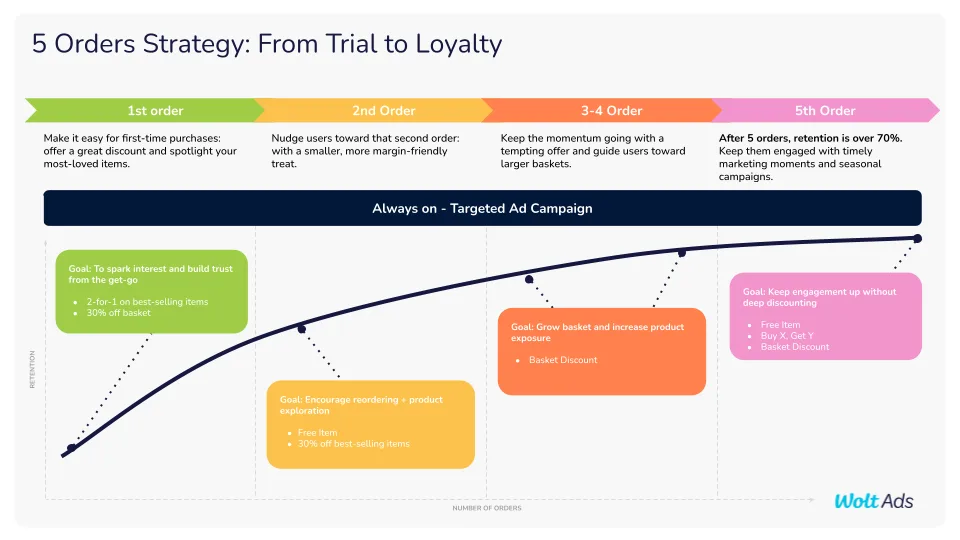
The 5 Orders Strategy helps you match your approach to how confident a customer feels at each stage.
Across Wolt markets and merchant types, we see a clear pattern in how customers behave. Early orders are about trust. Later orders are about habit. In fact, once customers reach their fifth order, retention is typically over 70%. That means customers who get to this stage are very likely to keep coming back.
Here is how customers typically think at each stage:
1st order: “Let’s see how this goes”
2nd order: “I would order here again”
3rd–4th order: “I will add something extra”
5th order and beyond: “This is one of my go-to places”
Orders 1–2: Focus on trust, not bigger orders
At this stage, customers are still deciding whether your venue feels reliable. They pay attention to product quality, clear descriptions and pricing, and whether the order arrives as expected.
What works well
Simple, familiar offers that reduce hesitation work best here. Good examples include:
XX% off a best-selling item This lowers the risk for first-time customers and encourages them to try what you are known for (for example, 20% off your most ordered product).
Buy two of the same item, get one free This works well when the item is frequently ordered and easy to understand.
A free item Added to the order as a small thank-you
A basket discount on smaller orders For example, a percentage off or a fixed amount in local currency once customers spend over a minimum. This keeps the offer simple while gently encouraging customers to complete their order.
These offers help customers place their first or second order with confidence, without pushing them to spend more than they are ready to.
Why this works
Customers feel safer choosing familiar items
Clear offers make the decision easier
What to avoid
Pushing customers to place a much bigger order too early Customers are still deciding whether they trust your venue. Trying to push higher order sizes at this stage can create hesitation instead of confidence.
Promoting items with limited availability Highlighting products that are often out of stock can be frustrating for customers and break trust early on. Focus instead on items you can reliably fulfill.
Orders 3–4: Start encouraging customers to add more items
By the third or fourth order, customers already trust your venue. This is the right moment to focus on bigger orders and exposing customers to more of what you sell.
Customers are more relaxed at this stage and more open to adding extra items and discovering more.
What works well
At this stage, basket discounts work best. They encourage customers to add more items without discounting individual products.
Basket discounts can be set as a percentage off the order total or a fixed amount, once customers reach a minimum spend.
For example:
Percentage % discount (e.g. 20% off orders over €30) This type of discount scales with the size of the order. The more items customers add, the bigger the savings. The final discount is calculated at checkout, which makes it slightly less obvious upfront, but more effective for growing larger orders.
Fixed amount off the basket value (e.g. €5 off orders over €20) This option is simpler to understand. Customers immediately know how much they will save, which can reduce hesitation.
There is no single “right” percentage or amount. What matters most is choosing a discount level that feels achievable for your customers and encourages them to add one or two extra items.
Why this works
Both options work well. Percentage discounts tend to reward larger orders more, while fixed discounts are simpler and clearer for customers.
What to avoid
Setting the minimum spend too high If it feels unrealistic, customers will not try to reach it. For example, a €50 minimum when most orders are around €20 can discourage ordering. Use your average order value as a guide.
5th order and beyond: Keep engagement high with timely rewards
Our data shows that retention is typically over 70% once customers reach their fifth order. At this stage, customers already see your venue as reliable and familiar.
The goal now is not to win trust, but to keep customers engaged. Timely marketing moments and seasonal campaigns work especially well here, as long as deep discounts do not become the norm.
What works well
Offers should feel like a bonus rather than a requirement.
Good examples include:
A free item added to the order as a small thank-you
Buy X, get Y offers on frequently ordered items
Basket discounts, such as XX% off the full order, used for seasonal or timely moments
Why this works
Customers are already likely to return, so smaller rewards go a long way
These offers keep your venue top of mind without relying on constant discounts
You can encourage slightly bigger orders while protecting your margins
What to avoid
Running deep discounts all the time
Training customers to wait for promotions instead of ordering naturally
Turning repeat orders into long-term growth
The 5 Orders Strategy helps you understand where most of your customers are in their ordering journey, so you can choose the right type of offer at the right moment.
To get a better sense of your customer base, focus on a few simple signals:
How many of your orders come from first-time customers If a large share of your orders comes from first-time buyers, many of your customers are likely in the early stages. In this case, offers that build trust and steady visibility matter most.
How many of your orders come from Wolt+ subscribers Wolt+ customers are often familiar with offers on Wolt and tend to order more frequently. A higher share of Wolt+ orders can indicate that customers already know your venue and may be more open to adding items or responding to lighter rewards.
Looking at these patterns can help you decide whether to focus more on building trust, encouraging bigger orders, or keeping regular customers engaged.
You can review these trends and adjust your approach over time in the Merchant Portal. If you need help with offers or ads, contact Wolt via the chat in the Merchant App or the Merchant Portal. The Merchant Services team is available to support you.